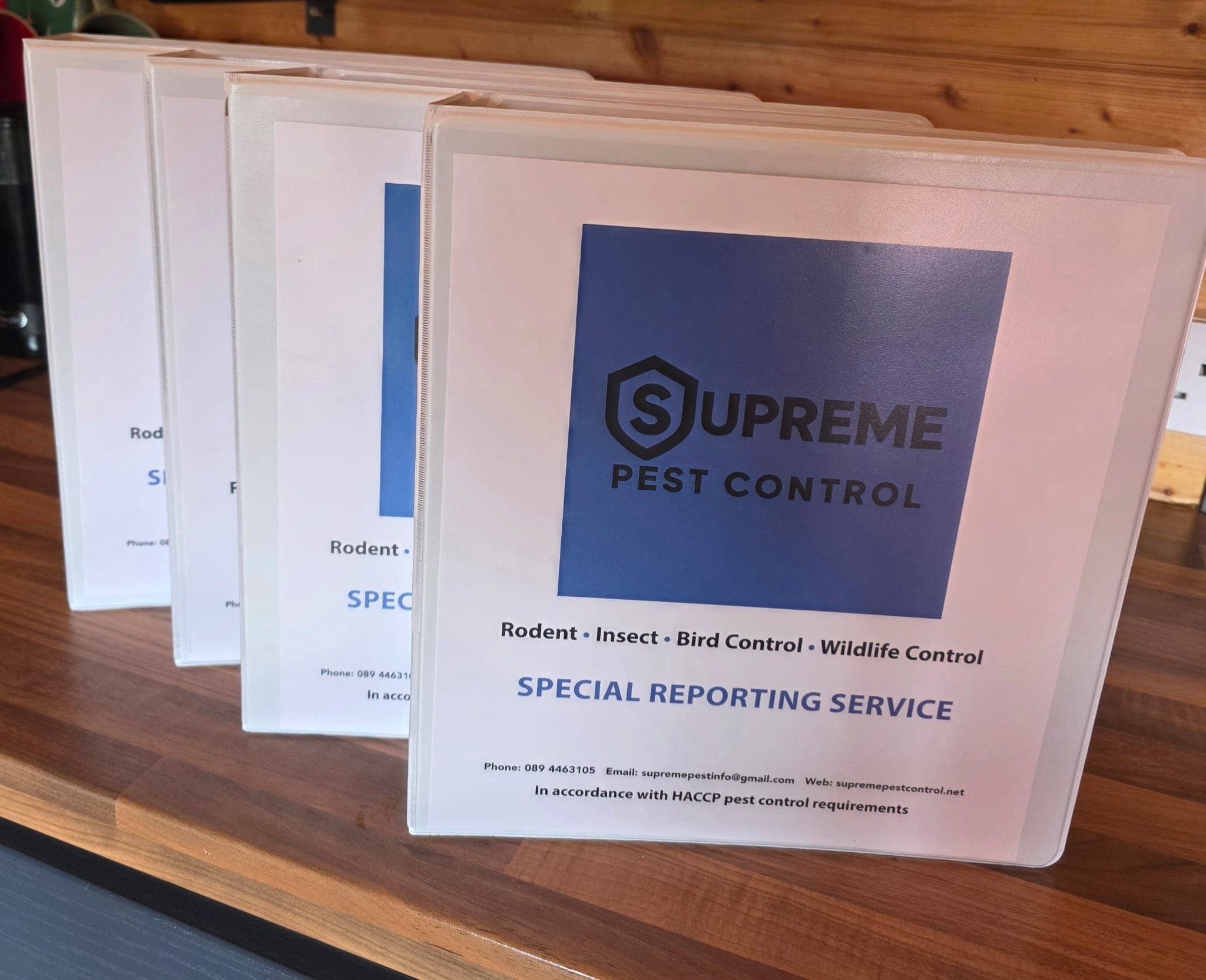
Maintaining commercial pest control records Dublin businesses can produce on demand is one of the most overlooked aspects of compliance management. If an Environmental Health Officer walked in today and asked for your service folder, could you produce a report from last month's visit, confirm when your monitoring devices were last checked, or show what action was taken after the last pest sighting? For many Dublin businesses, restaurants, hotels, offices, warehouses, and retail premises, the honest answer is no.
That is the problem this guide addresses. Not whether pest control is important, most managers understand that it is, but whether the paper trail behind it is being maintained properly. Documentation is where many otherwise well-run Dublin businesses fall short, and it is increasingly where inspectors, auditors, insurers, and landlords are focusing their attention.
This guide explains what a commercial pest control service folder is, what it should contain, when maintaining detailed records is a legal obligation and when it is strongly recommended best practice, and what every Dublin business manager should expect from a professional pest control company.
For restaurants and food businesses specifically, read our detailed guide: Restaurant Pest Control Dublin: EHO & FSAI Compliance Guide →
What Is a Commercial Pest Control Service Folder?
A pest control service folder, sometimes called a pest control logbook or pest management documentation file, is the organised collection of records relating to all pest control activity at a commercial premises. It is maintained on-site and made available to inspectors, auditors, landlords, or insurers when required.
Quick Answer, What Does a Pest Control Service Folder Contain?
A commercial pest control service folder typically contains: the initial site survey report, a scaled site plan showing monitoring device and bait station locations, signed service reports from every technician visit, pest activity and sighting records, treatment records with Safety Data Sheets, technician recommendations and corrective action records, and copies of the contractor's DAFM PMU licence and insurance certificate.
The value of this folder is not just compliance, it is the auditable history of a business's pest management programme. It demonstrates that pest activity has been monitored, that infestations have been treated, that recommendations have been acted upon, and that the contractor carrying out the work is properly licensed. Across Dublin's commercial districts, from the food businesses of Dublin 2 and the Liberties to the industrial estates of Ballymount and the distribution warehouses of Swords, this documentation is increasingly expected as a baseline, not an optional extra.
What Should a Pest Control Service Folder Contain?
A well-maintained folder is more than a stack of visit receipts. Each element serves a specific purpose and addresses a specific question an inspector might ask.
The survey carried out before or at the start of the pest management programme. It identifies current pest pressures, structural vulnerabilities, and the baseline condition of the premises. This is the foundation document of your pest management documentation, without it, there is no context for the service reports that follow.
A schematic of the premises showing the numbered location of every rodent bait station, insect monitor, fly killer unit, and other monitoring device. Without this plan, a service report listing 'Station 4, activity noted' is meaningless to an inspector. The plan must be kept current, if a station is moved, the plan must be updated.
The most frequently requested document during an EHO inspection records review. Each service report should record the date and duration of the visit, which monitoring devices were checked, what activity or evidence was found at each station, what treatments were applied and with which products, and any recommendations for corrective action. A service report that says only 'premises inspected, all clear' provides very little useful information.
A pest activity log maintained by the business between professional visits. Staff should record any pest sightings, a mouse in the stock room, a wasp near the delivery door, with the date, location, and what action was taken. An active pest activity log demonstrates management engagement and is viewed positively by inspectors.
Whenever a chemical treatment is applied, the product name, registration number, concentration, and quantity used should be recorded. These form part of your pest control compliance records. Safety Data Sheets for every product used on the premises must be held on file and accessible. Your contractor should provide these as a matter of course.
When a technician identifies a structural issue, a gap under a door, a damaged drain, a waste management problem, that recommendation should be recorded in writing and the business's response documented. Acting on recommendations and recording that action is one of the strongest indicators of good pest management practice.
A copy of the attending technician's DAFM Pest Management Trained Professional User (PMU) licence, the company's public liability insurance certificate, and any relevant accreditations such as CRRU Wildlife Aware certification. These confirm that the pest control work is being carried out legally and to professional standards.
Legal Obligation, Regulatory Expectation, or Best Practice?
This distinction matters. Not every commercial premises in Ireland has the same documentation obligations, and it is important to understand where your business sits on this spectrum.
Under EU Regulation (EC) No 852/2004 on the hygiene of foodstuffs, transposed into Irish law and enforced by the FSAI, all food businesses in Ireland are legally required to implement HACCP-based food safety management systems. Pest control is a core prerequisite programme within HACCP and must be documented. This means food businesses are not merely encouraged to keep pest control records, documentation is part of their legal HACCP obligation.
For commercial premises subject to EHO inspections that are not food businesses, hotels, offices, healthcare facilities, pharmacies, there is no specific Irish regulation requiring a pest control folder. However, EHOs and other inspectors routinely expect evidence of pest management when they visit. Inability to produce service records during an inspection is a compliance concern, even where no specific documentation regulation applies.
Every commercial premises, whether regulated or not, benefits from maintaining organised pest control records as evidence of due diligence. Records protect businesses during landlord inspections, insurance assessments, and any future dispute about the condition of a property. They demonstrate responsible property management.
The key takeaway: no Irish legislation uses the words "every commercial premises must maintain a pest control folder." What Irish legislation does require, for food businesses, is a documented HACCP system in which pest control is a core element. For all other premises, detailed pest control records represent sound business practice, meaningful evidence of due diligence, and protection against compliance concerns during inspections.
Restaurants, Cafés and Food Businesses: Why Documentation Is Non-Negotiable
Dublin's food sector, from restaurant-dense areas like Dublin 2, Rathmines, and the Liberties to the food manufacturing units of Ballymount and the catering businesses of Sandyford and Dundrum, operates under the most stringent pest control expectations of any commercial category.
The FSAI and EHO enforcement position
The FSAI and local authority Environmental Health Officers enforce food safety legislation across Ireland. During an inspection of a food business, an EHO will assess pest control as part of the HACCP prerequisite programme review. They will expect to see evidence of an active, documented pest management programme. An inability to produce this documentation, even if the premises is in good condition, is a compliance concern that can result in an improvement notice. Where there is active pest evidence and no documentation, the consequences can include prohibition orders and FSAI closure orders, which are published publicly and can cause lasting reputational damage.
In practical terms, this means Dublin food businesses should maintain pest control records that demonstrate: regular scheduled visits by a DAFM-licensed contractor, records of what was found and what action was taken, an up-to-date site plan, staff pest sighting logs, and evidence that recommendations made by the contractor have been acted upon. The FSAI has noted that in 2023, a significant proportion of closure orders issued to food businesses in Ireland involved pest-related activity. For more detail on EHO expectations for food businesses specifically, read our Restaurant Pest Control Dublin: EHO & FSAI Compliance Guide.
Hotels, Offices, Warehouses and Retail Premises in Dublin
Non-food commercial premises across Dublin operate under different but not absent expectations around pest control documentation.
Hotels and accommodation
Dublin hotels, from city centre properties in Dublin 1 and Dublin 4 to suburban hotels in Sandyford and Blanchardstown, face regular EHO inspections and guest-review scrutiny. A pest sighting by a guest can cause immediate reputational damage, TripAdvisor complaints, and booking platform penalties. Documented pest management provides both a deterrent record and evidence of responsible management.
Offices and commercial workplaces
The Health and Safety Authority (HSA) has broad powers to inspect commercial workplaces across Dublin. While pest control is not specifically legislated in the same way as for food businesses, the obligation to maintain a safe and hygienic workplace applies to all employers. Documented pest management is evidence of that obligation being met.
Warehouses and distribution centres
Premises in Ballymount, Clondalkin, Tallaght, and Dublin's industrial estates store goods that are vulnerable to pest contamination, particularly stored product insects and rodents. Retailers and food suppliers frequently require documented pest management records as a condition of supplier contracts and third-party audits.
Retail premises
Retail businesses in high-footfall areas across Dublin City Centre, Dundrum, Blanchardstown, and Swords face both EHO oversight and landlord compliance requirements. Many commercial leases include obligations around the maintenance of the property in a pest-free condition, with records available on request.
What Happens During an EHO Pest Control Inspection in Dublin?
EHO inspections in Dublin can occur with or without advance notice. For food businesses in particular, unannounced inspections are the norm. Understanding what an EHO is looking for removes the anxiety from the process, and makes clear why documentation matters independently of any actual pest activity.
The EHO will look for droppings, gnaw marks, damaged packaging, pest sightings, and structural vulnerabilities that could allow pest access. The absence of active evidence is positive, but it does not replace the need for documentation.
Can the business produce service reports from a licensed contractor showing regular monitoring visits? A clean premises with no records can still receive a compliance concern because there is no evidence that pest management is being actively managed rather than passively ignored.
A folder full of reports from 18 months ago is not evidence of an active programme. Current records, including the most recent visit, are what demonstrates ongoing management rather than a historical one-off exercise.
If a previous report recommended sealing a gap or improving waste management, the EHO will check whether that action was taken. A pattern of recommendations without corrective action is a significant compliance concern.
The EHO may ask whether the pest controller used by the business holds a DAFM PMU licence. Using an unlicensed contractor for rodent treatment, for example, may mean that the chemicals used were applied illegally, and that the records produced carry no regulatory weight.
Why Treatment Reports and Follow-Up Records Matter
A service report that documents only "premises inspected, all clear" is of very limited value. A well-written treatment report is a different document entirely.
What a useful service report should include
Follow-up documentation is equally important. When a technician recommends sealing a pipe penetration or replacing a drain cover, the business should record what action was taken and when. This demonstrates an actively managed programme rather than a passive one, and it is this demonstration of active management that both protects the business during inspections and reduces actual pest risk over time.
How Often Should Pest Control Records Be Updated for a Dublin Business?
There is no universally prescribed frequency set out in Irish law for commercial pest control visits in non-food premises. For food businesses, HACCP principles require monitoring to be appropriate to the risk, and EHO practice across Dublin has established monthly professional visits as the generally expected minimum for higher-risk food premises.
| Business type | Recommended visit frequency | Record update requirement |
|---|---|---|
| Restaurant, café, takeaway (Dublin) | Monthly minimum | After every visit, plus staff pest activity log between visits, FSAI audit ready |
| Hotel / food service venue | Monthly minimum | After every visit, plus staff sighting log between visits, integrated pest management programme required |
| Food production / processing | Fortnightly to monthly | After every visit, HACCP prerequisite programme documentation required; higher-risk environments may need more frequent records |
| Office / retail premises | Quarterly as minimum | After every visit, update immediately after any pest sighting; retain pest control service records for at least one year |
| Warehouse / distribution (Ballymount / Clondalkin) | Monthly to quarterly depending on stored goods | After every visit, with specific records for any stored product pest activity and bait stations checks |
Digital vs Physical Pest Control Records for Dublin Businesses
Both approaches are used across Dublin commercial premises and both are acceptable, provided the records are complete, current, and accessible during an inspection.
Physical folder on-site
- ✓Immediately accessible during an unannounced EHO visit
- ✓No technology dependency, accessible regardless of internet connectivity
- ✓Easy to produce for inspection, hand the folder to the officer directly
- ✕Vulnerable to loss, damage, or flood, no backup
- ✕Requires manual filing discipline to stay current
Digital records (email / portal)
- ✓Automatic backup, records cannot be lost or damaged
- ✓Easy to search and retrieve specific reports quickly
- ✓Accessible remotely by managers across multiple sites
- ✕Requires a device and internet access during an inspection
- ✕May require printing for some inspector preferences
Many Dublin businesses use both, maintaining a physical on-site folder for immediate inspection access while keeping digital records in a cloud folder or email archive for longer-term retention and multi-site management. The FSAI guidance on HACCP records states that records should be retained for an appropriate period, most Dublin food businesses and their advisors treat a minimum of one year as standard practice, with longer retention periods for higher-risk operations.
What a Professional Commercial Pest Control Company in Dublin Should Provide
Not all pest control companies provide the same standard of documentation. If you are commissioning a commercial pest management programme for a Dublin business, these are the minimum documentation standards you should expect as part of the service.
Not a verbal briefing, a written document you can file and refer back to.
Updated when devices are added, removed, or relocated.
Including findings, activity levels at each monitoring station, products used, and recommendations for corrective actions.
Filed with the report they relate to, for immediate reference during an EHO inspection.
Confirm the individual attending has their own PMU number, not just the company.
Before any structural work such as proofing or drain survey work begins.
Emergency visits should be documented to the same standard as scheduled visits.
Supreme Pest Control provides full HACCP-compliant documentation for all commercial pest control clients across Dublin and surrounding counties. Every commercial visit produces a signed service report, site plan updates where required, SDS sheets for any products applied, and a clear record of any recommendations or corrective actions identified. To discuss your documentation requirements, call or WhatsApp us on +353 89 446 3105.
Common Pest Control Documentation Mistakes Made by Dublin Businesses
- ✕Keeping no records at allThe most common situation we encounter when taking on new commercial clients in Dublin. The business has had pest control visits, but no documentation was ever requested or filed. 'We had someone out six months ago' is not a pest management programme.
- ✕Relying on a single old certificateA pest control certificate from a one-off treatment two years ago does not demonstrate an ongoing programme. Inspectors understand the difference between a historic one-off treatment and active, continuous pest management.
- ✕Not recording staff pest sightings between visitsA staff member sees a mouse and mentions it verbally but nothing is written down. When the EHO asks what was done in response, there is no record that the sighting was even noted.
- ✕Accepting vague service reports'All monitoring stations checked, no activity noted', with no device-by-device breakdown, no product records, and no recommendations. This type of report provides little compliance protection and tells the business almost nothing about its actual pest risk.
- ✕Not updating the site plan when devices are movedA bait station is moved from the dry store to the service area, but the site plan still shows it in the original location. During an EHO inspection, the discrepancy between the plan and physical reality raises immediate questions.
- ✕Not confirming contractor credentials before engagingUsing a pest controller who cannot provide a DAFM PMU number means that any rodenticide application may have been carried out illegally. Records produced by an unlicensed contractor carry no regulatory protection for the business.
Free Assessment for Dublin Businesses
Is Your Pest Control Documentation EHO-Ready?
Supreme Pest Control provides a free compliance assessment for Dublin commercial premises. We review your current documentation, identify any gaps, and establish a fully documented pest management programme that satisfies EHO, FSAI, and audit requirements.
How to Build Your Pest Control Service Folder: A Step-by-Step Guide
Confirm the attending technician's individual PMU number. Request copies of public liability insurance and any relevant accreditations, such as CRRU Wildlife Aware certification for rodent programmes. File these as the opening documents in your folder.
The first visit should produce a written survey. This is the baseline document, it identifies current pest pressures, structural vulnerabilities, and proposed monitoring arrangements.
Request a schematic of your premises showing the exact numbered location of every monitoring device. File this prominently in the folder and update it whenever devices are added, removed, or relocated.
Do not let reports accumulate in email. After each visit, file the signed service report in chronological order. Assign this responsibility to a named member of staff.
A simple notebook or printed logbook at the premises for staff to record any pest activity between visits. Train staff on what to record, date, location, what was seen, and what immediate action was taken.
When a recommendation is acted upon, a gap sealed, a drain cover replaced, a waste management procedure changed, record what was done and when. This turns a recommendation into a demonstrable corrective action.
Safety Data Sheets should be filed alongside the service report for the visit in which the product was applied. This allows any inspector or auditor to immediately match product records to application records.
A pest control folder that falls out of date is of limited value. Designate one person responsible for maintaining it, set a quarterly reminder to review completeness, and ensure the folder is accessible, not locked away or stored off-site.
Common Questions
Frequently Asked Questions
Practical answers about commercial pest control records, service folders, and compliance documentation for Dublin businesses.
What should a commercial pest control service folder contain?
A well-maintained pest control service folder holds your initial site survey, a scaled site plan showing every monitoring device location, signed service reports from every technician visit, pest activity records, treatment records with product names and Safety Data Sheets, technician recommendations, corrective action records, and copies of your contractor's DAFM PMU licence and insurance certificate.
Is a pest control service folder a legal requirement for businesses in Ireland?
There is no Irish law that requires every business to maintain a folder with that exact label. However, food businesses are legally required under EU Regulation (EC) No 852/2004 to implement HACCP-based food safety management systems, and pest control documentation is a core part of that obligation. For non-food businesses, detailed records are strongly recommended as evidence of due diligence during EHO, HSA, insurance, or landlord inspections.
Do restaurants in Dublin need pest control records?
Yes. EHOs inspecting Dublin restaurants will expect to see evidence of an active pest management programme. Service reports showing a licensed contractor has visited, records of any pest activity and actions taken, and current monitoring in place are all typically expected. Without these, even a clean premises may receive a compliance concern.
How often should pest control records be updated?
Records should be updated after every scheduled visit and every emergency call-out. For most food businesses in Dublin, monthly visits are the expected minimum. Any pest sightings observed between visits should be logged by staff. The folder should be current at all times, EHOs may arrive unannounced.
What happens during an EHO pest control inspection in Dublin?
The EHO will assess whether pest prevention measures are in place, whether there is evidence of pest activity, and whether the business can demonstrate an active, documented pest management programme. They will typically ask to see service reports, the site plan, and records of corrective actions taken.
Should pest control records be kept digitally or in a physical folder?
Both are acceptable. Many Dublin pest control companies now provide digital reports by email or online portal. What matters is that records are complete, organised, accessible during an inspection, and retained for an appropriate period, typically at least one year. Many businesses maintain a physical folder on-site and a digital archive for longer-term records.
What is the difference between a pest control service report and a pest control certificate?
A service report is a detailed record of a specific technician visit, findings, treatments, and recommendations. A certificate confirms that a one-off treatment was carried out, such as wasp nest removal. Commercial businesses need ongoing service reports, not single certificates, to demonstrate a continuing pest management programme.
What are the most common pest control documentation mistakes made by Dublin businesses?
The most common mistakes include: keeping no records at all, relying on a single old treatment certificate, not recording staff pest sightings between professional visits, accepting service reports that are too vague to be useful, not updating the site plan when monitoring devices are moved, and not confirming that the pest controller is DAFM licensed before engaging them.
Authoritative Sources
Related Guides
Ready to Get Your Documentation Right?
Commercial Pest Control for Dublin Businesses, Fully Documented
Supreme Pest Control provides complete HACCP-compliant pest management for restaurants, hotels, offices, warehouses, and retail premises across Dublin D1 to D24, County Meath, Kildare, and Wicklow. Every visit is documented. Every report is EHO-ready. Free compliance assessment available.
DAFM PMU Licensed · Fully Insured · HACCP-Compliant Documentation · Monthly Contracts · Dublin D1–D24